Handbag Storage in a Small Closet
A handbag collection can be small and still become tangled when straps overlap and soft bags collapse behind structured ones. Choose positions according to the bags' shapes, care needs and frequency of use. Start with the few pieces carried regularly.
This is an organization guide rather than a universal material-care method. Follow the maker's advice for each bag, particularly delicate finishes and valuable pieces.
Separate daily bags from occasional bags
Give the current daily group the clearest appropriate position. Keep occasional pieces in another suitable section rather than reaching over them each morning. Include the actual bag size when it is prepared for use.
Remove contents that need another home, including anything requiring secure storage. Camel and peony details can distinguish the sections through a label or shelf divider while the bags retain their own colors and materials.
Start by naming the daily group: perhaps the work bag and a small cross-body bag used for errands. Keep each one's removable strap and other components associated with it. When changing bags, give the contents a temporary sorting surface so keys, receipts and personal items do not collect in the unused bags. Return anything needing restricted access to its own secure home.
Support bags in an appropriate shape
Use the shape and storage arrangement recommended for the individual bag. Some pieces may need appropriate support rather than being folded into a narrow gap. Do not assume one stuffing or hanging method suits every material and construction.
Check the support surface and the space around the bag. A structured piece should not have to be forced between another bag and a cabinet side. Give it enough room to be removed without scraping or pulling neighboring pieces with it.
Start with the bag maker’s own care advice. For example, Coach's leather-care guide recommends suitable shape support, a breathable cover and avoiding extended hanging by the straps for the leather bags it describes. That is a maker-specific example, not a care recipe for every handbag. Use the advice for your actual material, finish and construction before choosing a shelf, hanger or cover.
Use dividers only when they help
A suitable divider can separate a modest row on an existing shelf. Check its stability, surface compatibility and the space it takes from the usable width. Avoid a rigid organizer whose slots suit only one of the bags you own.
Our tiny closet organization guide can help assess the larger wardrobe. Test a small section first. The divider is useful when it makes individual pieces easier to retrieve, rather than merely producing evenly spaced gaps.
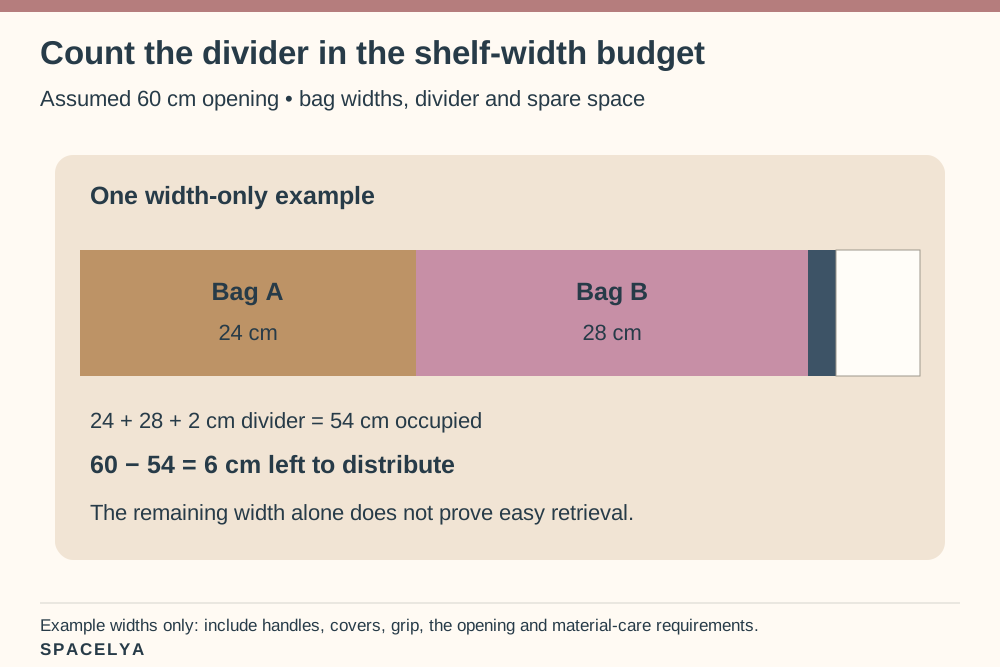
Check the width budget before buying dividers. In an assumed 60 cm shelf opening, bags needing 24 cm and 28 cm of width already take 52 cm. A 2 cm divider brings that to 54 cm, leaving 6 cm to distribute. Those are example widths only: handles, protective covers and the space needed to grip and remove the bags still matter. Even a slim organizer takes room away from the collection.
Keep straps from tangling
Arrange straps according to the bag's care guidance, keeping them clear of neighboring handles and door tracks. Give removable components a suitable identifiable home with their bag where practical. Avoid a loose drawer of straps whose matching pieces are elsewhere.
If hanging is permitted for a particular bag, check the support and loaded condition rather than assuming any hook will do. A high hook with several overlapping bags can make the collection harder to manage.
Store occasional bags as their makers advise
Keep relevant covers, identification and care information with the piece. Use the recommended conditions and avoid applying a generic storage-life or preservation rule to every finish. A closed case or cover is useful only when it suits that bag.
Keep the group accessible enough to remember. Our bedroom clothes-storage ideas can help reserve an appropriate accessory section without turning the entire wardrobe into handbag display storage.
If a maker recommends a dust cover, identify the covered bag in a way that does not mark or damage it. A shelf label or note on the storage position may be enough. Keep care cards somewhere you can actually find them before storing an unfamiliar finish. Do not apply a general cleaning or conditioning product simply because the bag is going into storage.
Leave retrieval space around handles
Take the bag used most often from its proposed position and return it. Check that the handle is easy to grasp and the opening does not catch a neighboring strap. Include wardrobe doors and any drawers beneath the shelf.
Adjust the group before adding more storage. A modest daily selection with a comfortable return position is more useful than a densely packed collection that looks tidy only after everything has been arranged by hand.
Test the shelf with the wardrobe in its normal state, including clothes hanging beside it. Take out the daily bag, then the occasional one behind or beside it. If a long strap catches the clothes rail or a handle needs to be forced past the door, change the position. Leave the easiest return space for the bag that comes home every evening.
Should all handbags be hung?
No. Construction, weight and material-care instructions differ. Use the maker's guidance and an appropriate support method for each piece. A shelf position may suit one bag while another has a different recommended arrangement.
About the illustrations
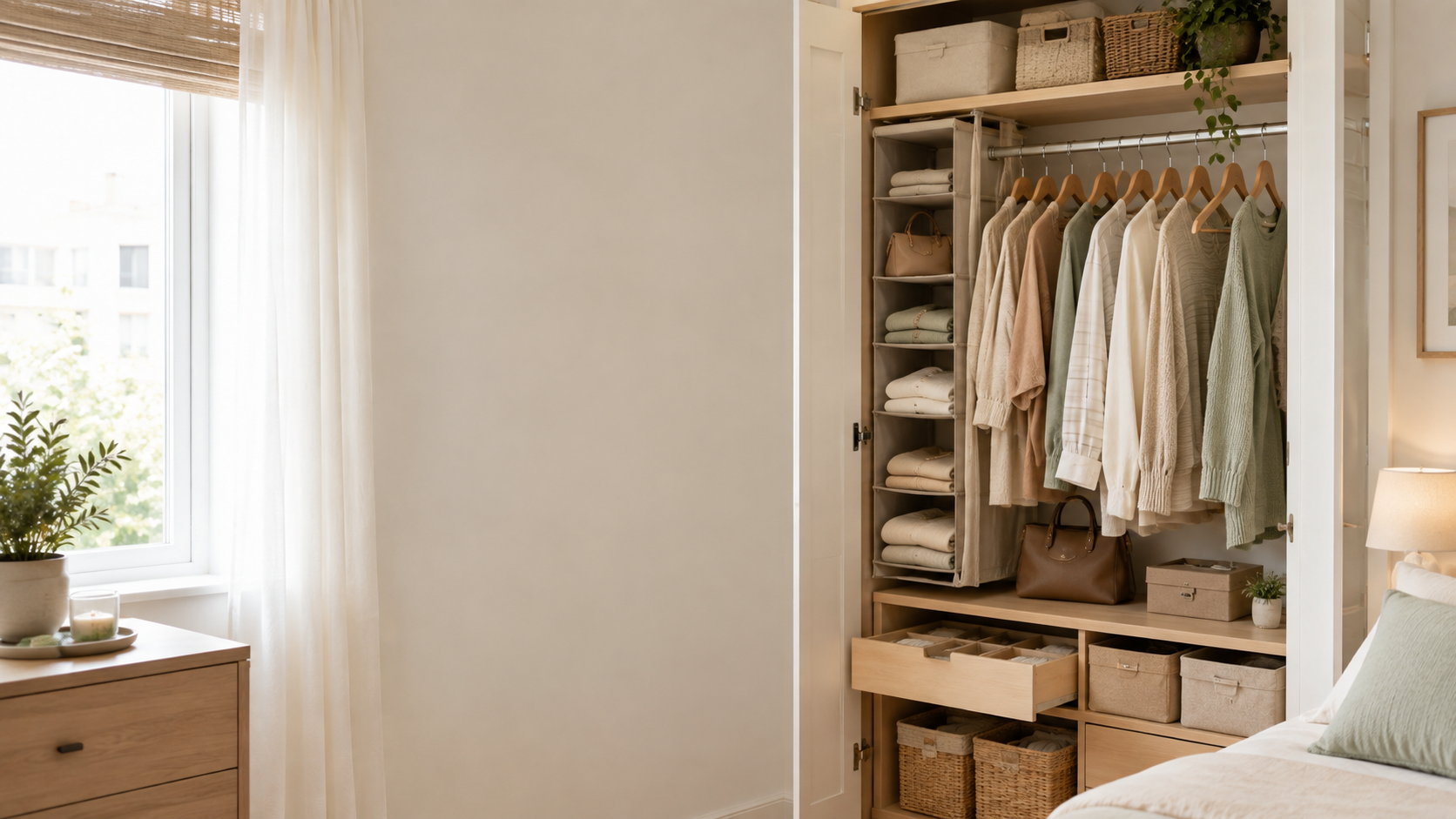
The wardrobe scene is a reused SPACELYA styling illustration. The original width graphic uses explicitly assumed figures. These are planning references, not measurements of the pictured bags or proof that any material-care method suits every bag.
A beautiful small space is not about having more. It is about making what you have work better. — Spacelya