Pots, Pans and Lids: Storage That Fits a Small Kitchen
The pan you need is usually underneath the one you used yesterday. Add a lid balanced between the handles and a small cabinet becomes an awkward place to begin dinner. A better cookware arrangement starts with the pieces you cook with, then gives each one a route out of the cupboard.
Work on a single low cabinet or drawer first. Keep heavy pieces accessible, make stacks modest and treat lids as a separate storage problem. You can often improve the arrangement before buying a rack.
Count the cookware you use
Set out your pans and think through an ordinary week's meals. A frying pan, saucepan and larger pot may account for most cooking, while a duplicate pan is used only when guests visit. Put the regular pieces back first. Store genuinely useful occasional cookware in a less convenient position that remains manageable to reach.
Check which lids fit which pans. A lid shared by two pieces can reduce the number you need to accommodate. Set aside damaged or unsuitable cookware according to its maker's advice rather than organizing around it indefinitely.
Make the first arrangement around a real meal. If pasta night uses a saucepan, a small frying pan and one colander, those pieces should be reachable without moving the roasting pot kept for occasional visits. Keep a note of the awkward item for a week before buying a larger organizer.
Match each daily lid to its pan while everything is cold and empty. Where the maker confirms that a lid fits more than one item, one accessible lid position may serve both. Do not assume a similar diameter means the rim and lid are compatible.
Match pans to a low cabinet
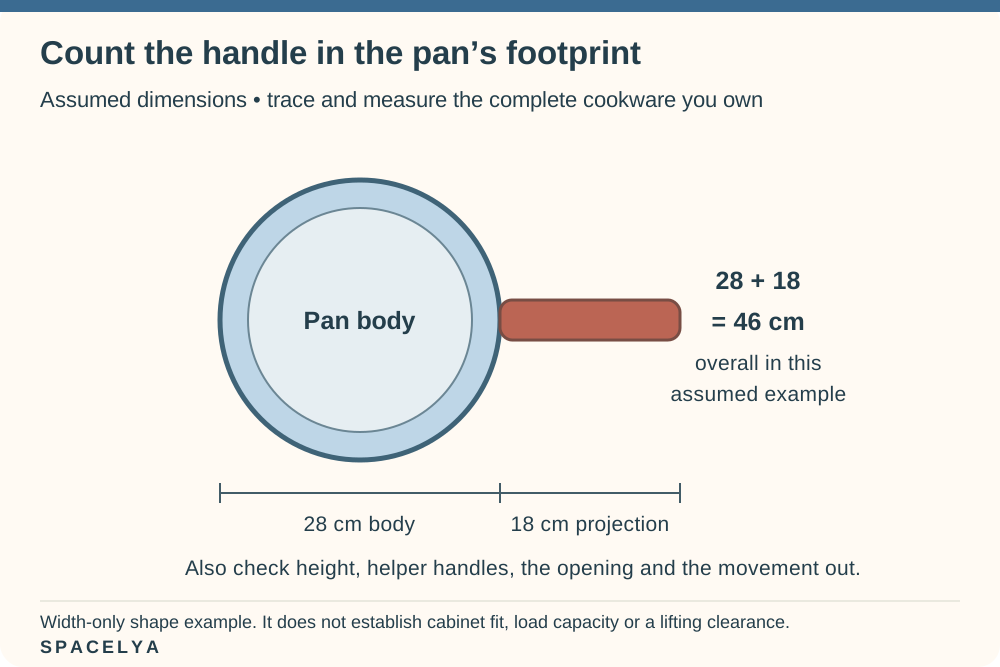
Measure the clear opening, shelf depth and available height, including handles. A pan's advertised diameter usually describes its body rather than the full storage footprint. Trace the largest piece onto paper if that helps you see how its handle affects the arrangement.
A deep drawer can provide a useful view from above, but check its load rating and the space taken by an insert. In a cupboard, position the heaviest piece where you can lift it without reaching over a row of smaller objects. Keep the cabinet's load limits in mind when grouping cookware.
For an assumed round pan, a 28 cm body and a handle extending 18 cm beyond its rim create a 46 cm overall outline in that direction: 28 + 18 = 46 cm. The advertised 28 cm size would not describe that storage length. These are example dimensions, not measurements of the illustrated cookware.
Trace the complete shape, including helper handles, and try its intended angle in the cupboard. Check the opening and the space needed to lift the piece out. A paper outline checks the plan shape; it cannot establish the height, weight or usable clearance of a loaded drawer.
Separate lids from handles
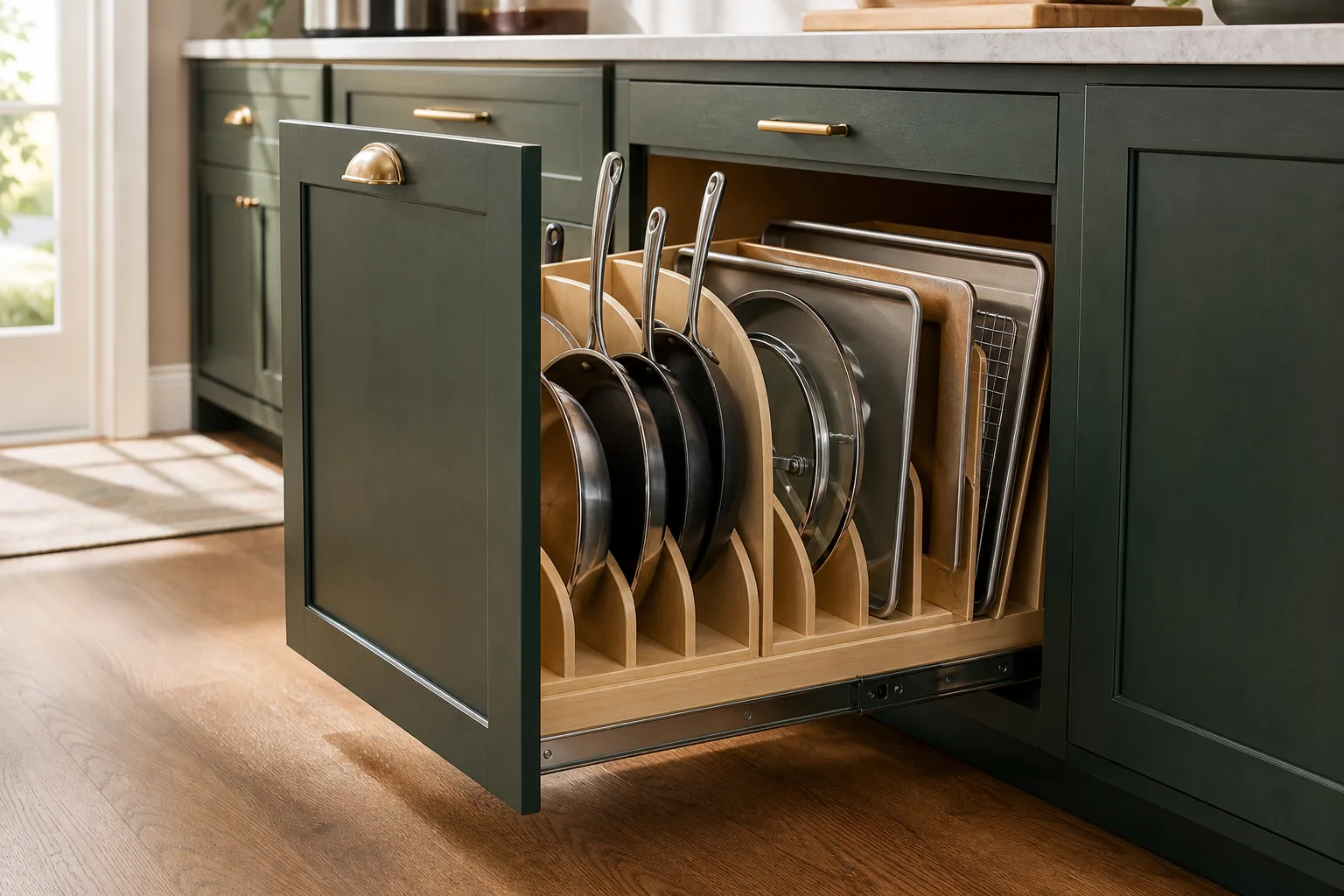
Try standing suitable lids in a stable divider beside the pans. Check the knobs as well as the lid diameter: a bulbous handle can prevent a drawer closing or make a slim rack surprisingly deep.
Give each lid a slot you can identify without lifting every other lid. If a cabinet-door rack looks promising, test the clearance with the door shut before installing it. Follow its mounting and load instructions. A rack that fits on an open door may collide with the handles inside when the door closes.
Nest only compatible pieces
Nesting can work well for a few pans designed to sit together. Follow the cookware maker's storage advice, particularly for finishes that need protection. Use an appropriate protector if recommended and let washed pieces dry before returning them.
Avoid building a tower merely because all the pans technically fit. Put a daily pan at the top or give it its own position. An occasional large pot can hold a compatible smaller piece, but it should not become the container for every utensil without a home.
Keep storage advice specific to the cookware you own. For example, Le Creuset's care guidance calls for dry storage and suitable protection between the products it describes when stacking. That is a product-specific reference, not a reason to assume unrelated finishes tolerate nesting.
If the daily pan must be lifted out of a heavy three-piece stack, the arrangement may save shelf space while making cooking harder. Give that pan its own accessible position and let the compatible occasional pieces share the less convenient stack.
Use a vertical rack for light pans
A stable rack may help with suitable lighter pans, especially when handles otherwise interlock in a pile. Check slot width, support and the height of the pan when it stands on its side. Follow the rack's capacity and intended-use instructions; a rack for light bakeware is not automatically suitable for heavy cookware.
Try the layout with your actual pans before committing the whole cupboard. A sky-blue divider or tomato-red pan already in use can add color when the door opens, without adding decorative objects to the shelf.
Test one-handed retrieval
With cold, empty cookware, see whether you can select a daily pan without dismantling the arrangement. This is a convenience check, not a requirement to lift a heavy piece with one hand. Use both hands whenever the piece calls for it.
Return each pan as though you were putting away the washing-up. If the lid has nowhere to go or a handle catches every time, adjust that position now. For other kitchen zones, see our small kitchen organization guide. Once the cookware has a reliable home, our countertop ideas for a small kitchen can help you keep preparation space useful.
Check returning the lids after washing as carefully as taking the pans out before dinner. A divider that depends on a precise order may work for one person and fail when another puts things away. Place the lid where its knob clears the shelf or drawer front and the matching pan is easy to identify.
Keep the arrangement that works with your normal cookware supply, including anything usually in use or drying. If the cupboard only fits after a piece is left on the stove, the storage plan still needs adjusting.
Should every pan have a separate slot?
No. A few compatible pieces can nest comfortably. Reserve separate positions for the cookware you use most often or find difficult to unstack. The useful arrangement is the one you can maintain after dinner, with lids and pans returning to obvious places.
About the illustrations
The room and storage scenes are reused AI-generated SPACELYA styling illustrations. They are visual references, not photographs of tested homes or products. The original SPACELYA planning graphic is explicitly illustrative; use the actual room, materials and product instructions when adapting the idea.
A beautiful small space is not about having more. It is about making what you have work better. — Spacelya