Dining Bench or Chairs: Which Fits a Small Eating Area?
A bench can tuck neatly beside a table, but the person in the middle still needs a way to get out. Chairs move independently, yet need room to pull back. Compare the seating while occupied instead of choosing from the tidy empty arrangement.
Start with the people who eat there every day. A compact dining area should support ordinary meals before it accommodates an occasional maximum number of guests.
Count the people who sit daily
List the regular occupants and consider their comfort and access needs. Do not assume that a bench's length establishes a fixed number of suitable seats. Test the usable space with the table legs and diners in position.
Someone who needs independent exit or particular back support may prefer a chair. Another household may enjoy a shared bench for a specific wall position. Choose the arrangement around the people, not the theoretical seating capacity.
Compare the same ordinary meal in each arrangement. Two people eating breakfast may be comfortable on a wall bench, while a third person who regularly leaves the table early changes the access problem. Draw each person's occupied place and how they would leave without moving someone else's meal. A seat count on a product listing cannot answer that for your room.
Check entry and exit at a bench
Map how each person reaches their place and leaves it. A bench against a wall may require sliding past another diner. Include the table base, wall returns and the space needed to move the bench itself.
Our studio dining-area guide can help compare corner arrangements. A bench is useful when its access works in the actual layout, not simply because it occupies a continuous strip beside the wall.
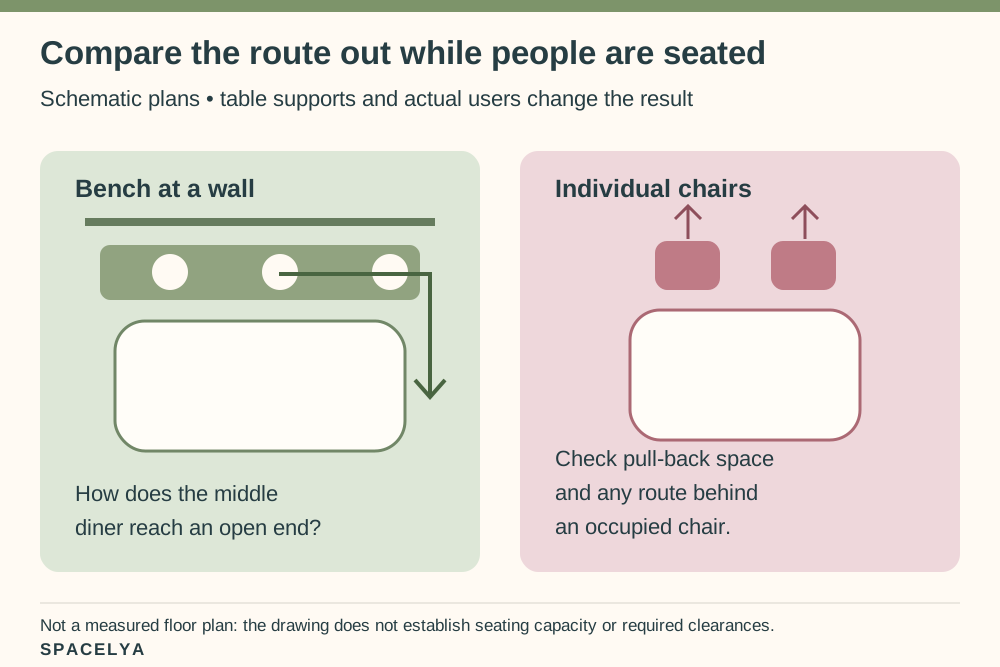
For a corner bench, trace the middle diner's route to an open end. A generous-looking tabletop can hide a pedestal or leg exactly where that person needs to turn. Try the motion with the furniture you own, without climbing over seating or leaning on an unsuitable table. If independent exit matters and that route does not work, use an individual chair or change the table position.
Leave room to move chairs
Pull the proposed chair back as though someone were sitting down or standing up. Include its back, arms and any projecting feet. A chair pushed under the table shows only its stored footprint.
Check the route behind an occupied seat. If the room relies on repeatedly moving another piece to let someone pass, reconsider the arrangement. Individual chairs can be flexible, but the available movement determines whether that flexibility is useful.
Test two moments separately: the chair pulled back while someone stands, and the chair occupied during the meal. Then ask whether another person still needs to pass behind it. Do the comparison with the nearby cupboard or kitchen drawer in normal use. Empty-room photographs and a chair pushed tightly under the table show neither of those conditions.
Compare back support and cleaning
Try the seating for the length of an ordinary meal. Consider appropriate seat height and support for the actual users, and check the products' intended use. A decorative perch may feel different from a comfortable dining seat.
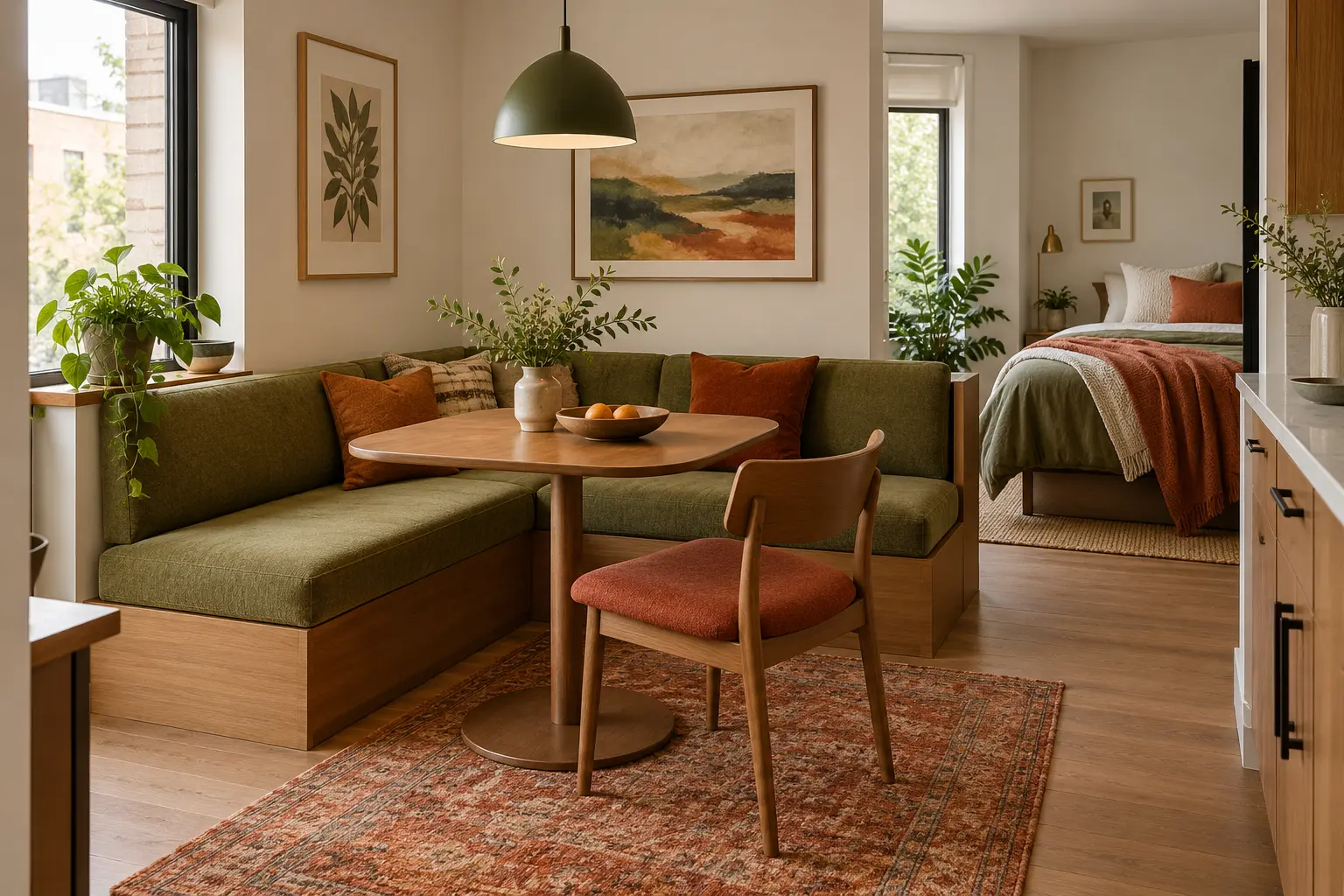
Look at how the floor and the space between seat and wall can be cleaned. Sage-colored upholstery with a cherry accent can make a compact setup cheerful, but choose materials around their real care instructions and the household routine.
Use mixed seating only when practical
A bench on one side and chairs on another can suit a particular room. Keep compatible seating heights and enough usable table edge for each person. Avoid adding a mismatched seat simply to make the arrangement look collected.
Compare the view with the furniture in normal use. A balanced mixture can be quite simple: one bench and two appropriate chairs may provide all the variety needed without another stool living in the walking route.
A practical mixed arrangement might put a bench along the less-used wall side and individual chairs on the side used for frequent entry. That is an option to test, not a rule. Check the bench ends, table supports and the needs of the people who use it. Keep any guest chair in a real storage position when it is not needed, rather than leaving it in the route.
Test before adding storage underneath
Storage under a bench or beside chairs still needs access. Check lids, drawers and the contents' weight with the seat in its intended position. A storage feature that requires clearing the dining area for every use may suit only occasional items.
Our small dining-area storage ideas cover other positions when seating should remain straightforward. Choose the bench or chairs first for sitting and access, then consider whether appropriate storage genuinely adds usefulness.
Sort proposed bench storage by how often it must open. A lid under the seated cushion may be acceptable for occasional table linens but inconvenient for napkins needed during dinner. A drawer opening toward the route needs its own operating space. Do not count hidden storage as a benefit until you have retrieved the intended item with the table and seats in place.
Does a bench always seat more people?
No. Usable length, table supports, comfort and access all affect capacity. Compare actual occupied positions rather than dividing the bench length into theoretical seats. The right arrangement lets the household eat and move comfortably every day.
About the illustrations
The dining nook is a reused AI-generated SPACELYA styling illustration. The original access diagram is schematic. Neither establishes seat capacity, measured clearances or the suitability of a particular arrangement for its users.
A beautiful small space is not about having more. It is about making what you have work better. — Spacelya