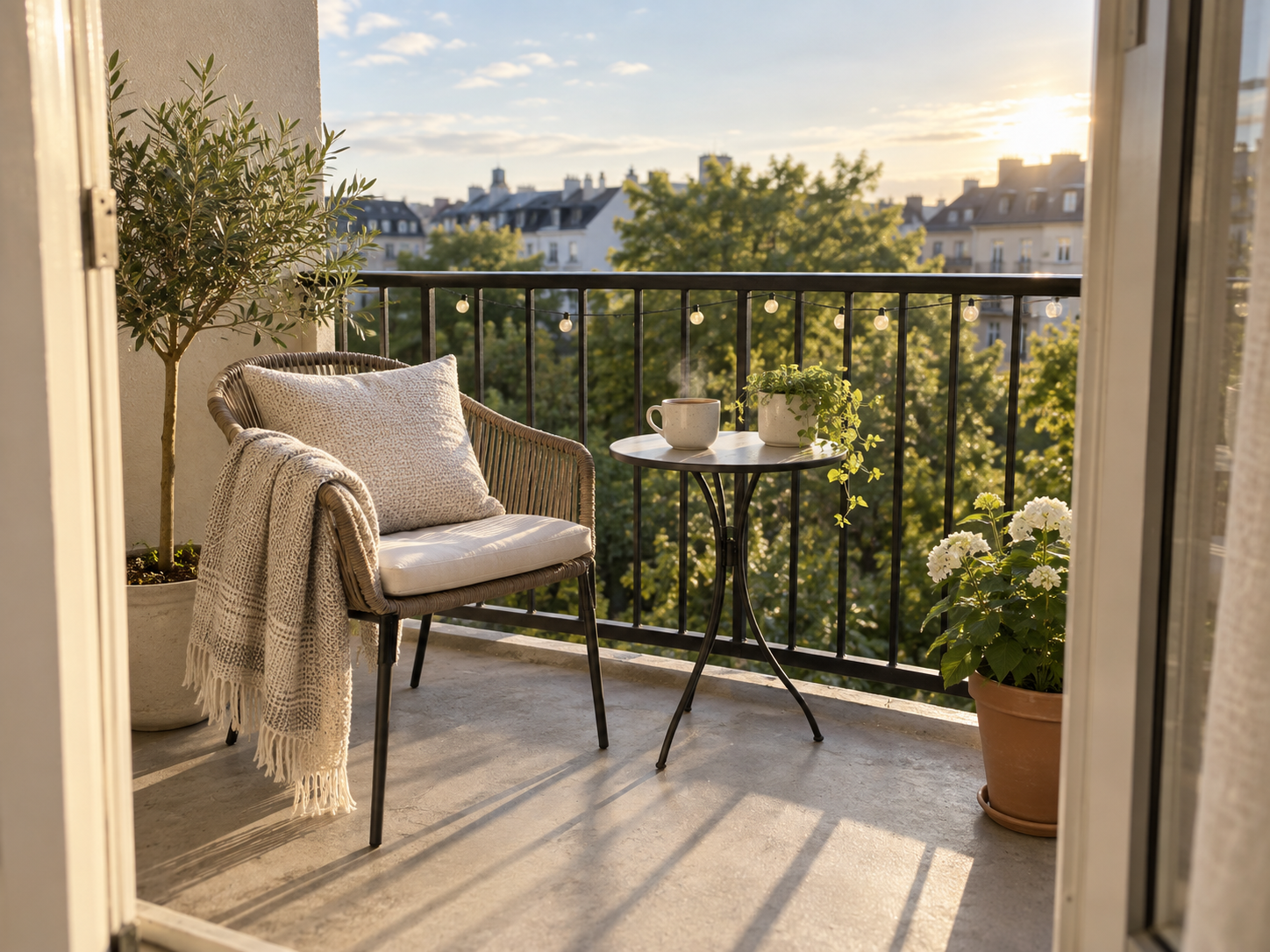
Balcony Privacy for Renters: Options and Limits
Privacy works best when it addresses a particular view. Before surrounding a small balcony with screening, identify where you feel overlooked while sitting or using the door. You may need a modest change in one direction rather than a barrier on every side.
Check the lease, building requirements and any necessary permissions before adding screens, panels or attachments. Wind, structural limits and safe access are specific to the balcony, not settled by a generic decorating photograph.
Map the actual overlooked view
Sit in the usual chair and identify the specific view that bothers you: a neighboring window, a shared passage or the view from a taller building. Check from the doorway too. A treatment designed for a person standing at the rail may do little for someone sitting farther back.
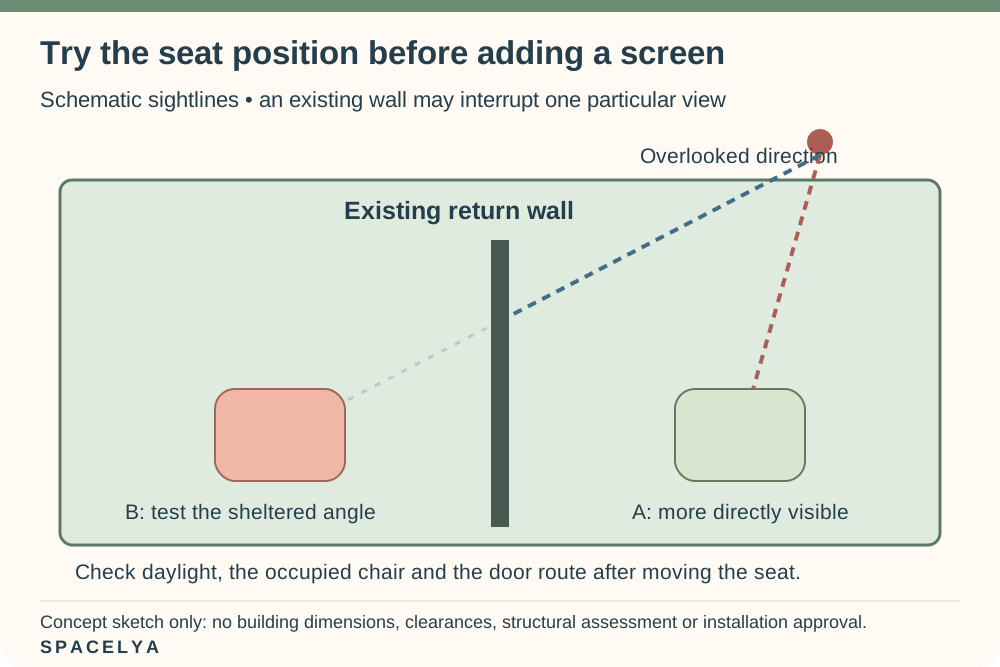
Sketch the balcony, its existing walls, the door and the direction of that view. Then try the chair at another angle, keeping the door and walking route clear. Moving the seat sideways may place an existing return wall between you and the neighbor without adding a screen.
Check the view at the time you normally use the balcony. Keep the daylight and sky view you enjoy. The diagram below explains the sightline idea only; its positions are schematic and give no building dimensions or permitted clearances.
Use existing architectural shelter
Look for a suitable chair position beside an existing solid wall or approved opaque section. Moving the seating may provide a more private angle without changing the balcony's structure or railing.
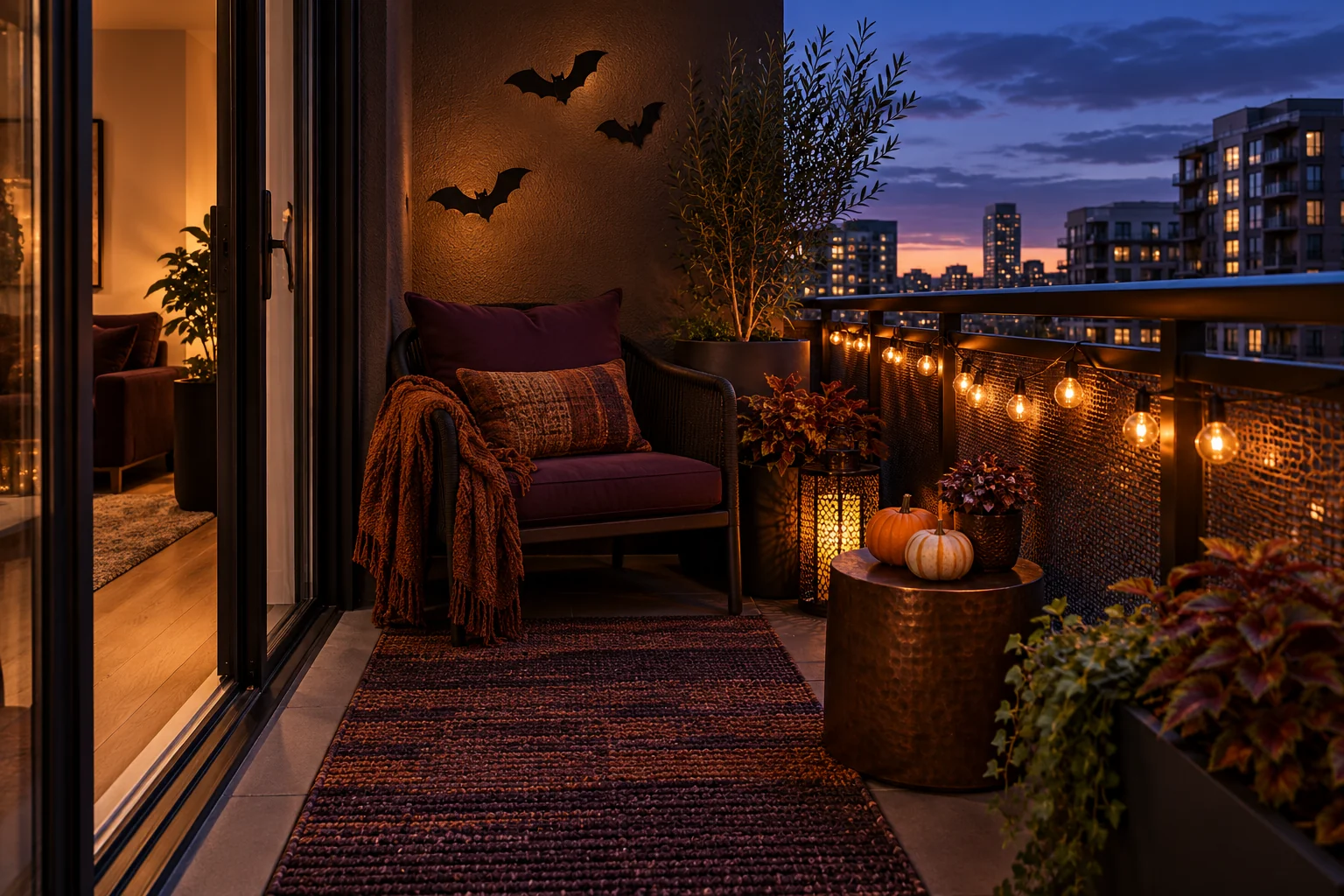
Our small balcony ideas for renters can help compare arrangements. Keep the complete chair footprint and door movement in the test. Sage seating with a coral textile can make a sheltered position feel deliberate rather than like a compromise.
Try the change with an actual cup or book in use. A sheltered chair that requires a table to sit in the doorway is not an improvement. Check the path back inside with the chair occupied and the door in its normal open position.
The most private position may face across the balcony rather than straight out. Let the furniture follow that use. Color can come from a cushion you already own; privacy does not require matching screens on every edge.
Compare a suitable freestanding screen
A screen needs to be suitable for the actual outdoor conditions, support and building requirements. Freestanding does not mean unaffected by wind or automatically permitted. Check the manufacturer's instructions and obtain appropriate advice before relying on it.
Keep it within an approved suitable position, clear of edges, doors and required routes. If the site cannot safely accommodate that product, choose another approach. Do not improvise weights or attachments to make an unsuitable screen seem stable.
Ask for the product's actual outdoor-use and weather instructions before buying it. Also decide where it goes when those instructions require removal or storage. An indoor room divider is not an outdoor screen simply because it folds.
If neither an approved installation nor a suitable storage place is available, stop at the seating change. No screen is a better outcome than a panel left outside because there is nowhere to put it. Do not use improvised weights, tie a screen to an unknown support or copy a fastening method from a styled image.
Keep railing changes conditional
Treat railing attachments, opaque panels and coverings as changes requiring the relevant approval and compatibility checks. They can affect loads and wind exposure as well as appearance. Do not copy an attachment method from another building.
Use existing approved screening where available rather than assuming the railing is a general-purpose support. Keep required openings and safety features intact. A privacy preference does not establish that an added panel is appropriate for the structure.
Use plants only within safe space and load limits
Plants may soften a view, but pots, supports and their loaded weight must suit the balcony. Account for water and the actual arrangement with appropriate building guidance. Keep containers securely within suitable positions rather than hanging them outward over an edge.
Check household needs, including avoiding furniture or planters that create a climbing opportunity near a guardrail. Choose species for the growing conditions and household suitability, not solely for the height they promise in a display.
Check the balcony after the privacy change
Reassess the door, sitting space, necessary access and the conditions the treatment introduces. Follow product guidance for weather and storage. Privacy should not leave the balcony dark, cramped or difficult to use.
For a separate seasonal layer, our fall balcony decorating ideas focus on useful color and textiles. Keep that decoration modest once the approved privacy arrangement is settled. The most successful change improves the specific sightline while retaining the balcony's ordinary function.
Write down what improved and what you gave up: perhaps a less direct view from one window, but less daylight at the table. This makes it easier to compare a modest change with a larger treatment. Reassess after ordinary use and follow the product's weather instructions; a calm-day photo cannot demonstrate wind performance.
Choose the smallest permitted arrangement that answers your particular sightline. You may still see the wider surroundings. Useful privacy in a small outdoor room does not always mean complete enclosure.
Is a freestanding screen always renter-friendly?
No. Permissions, wind exposure, support, loads and access still matter. Check the actual product and balcony before choosing it. Moving a chair within existing architectural shelter may be a more suitable solution when screening is unsupported.
About the illustrations
The room and storage scenes are reused AI-generated SPACELYA styling illustrations. They are visual references, not photographs of tested homes or products. The original SPACELYA planning graphic is explicitly illustrative; use the actual room, materials and product instructions when adapting the idea. No photograph or sketch demonstrates a safe railing attachment, structural load, wind performance or permission for a particular balcony.
A beautiful small space is not about having more. It is about making what you have work better. — Spacelya